Linux Privilege Escalation: From Dirty COW to RefluXFS — How Low-Privilege Shells Become Root
A hands-on tour of Linux privilege escalation — SUID, capabilities, race conditions, and kernel memory bugs explained through 16 famous LPE CVEs, from Dirty COW and Dirty Pipe to PwnKit, Januscape, and RefluXFS.
Introduction
In cybersecurity, getting the initial shell is only half the work. That shell can come from anywhere — a web server vulnerability, phishing, credential theft, a sloppy misconfiguration. And almost every time, you land as some low-privileged user who can barely read /etc/shadow, let alone touch it.
A shell that can’t compromise the system isn’t really a compromise. To truly own a Linux box you need to be root.
In this article I want to walk through the famous Linux Privilege Escalation (LPE) vulnerabilities — including several very recent ones — and keep it simple enough that anyone can follow along. Before we dissect the CVEs themselves, we’ll cover the terms and concepts they’re built on, because these vulnerabilities make a lot more sense once you understand what they’re actually breaking. The same way you’ve always wanted to understand your girlfriend.
Here’s the full list of LPEs we’ll cover:
- Dirty COW
- Dirty Pipe
- Copy Fail
- Dirty Frag
- Fragnesia
- PEdit-CoW
- Januscape
- PwnKit
- OverlayFS
- Netfilter Use-After-Free
- sudo “Baron Samedit”
- eBPF Verifier Bug
- Netfilter x_tables Heap OOB
- ptrace Exit-Race
- RefluXFS
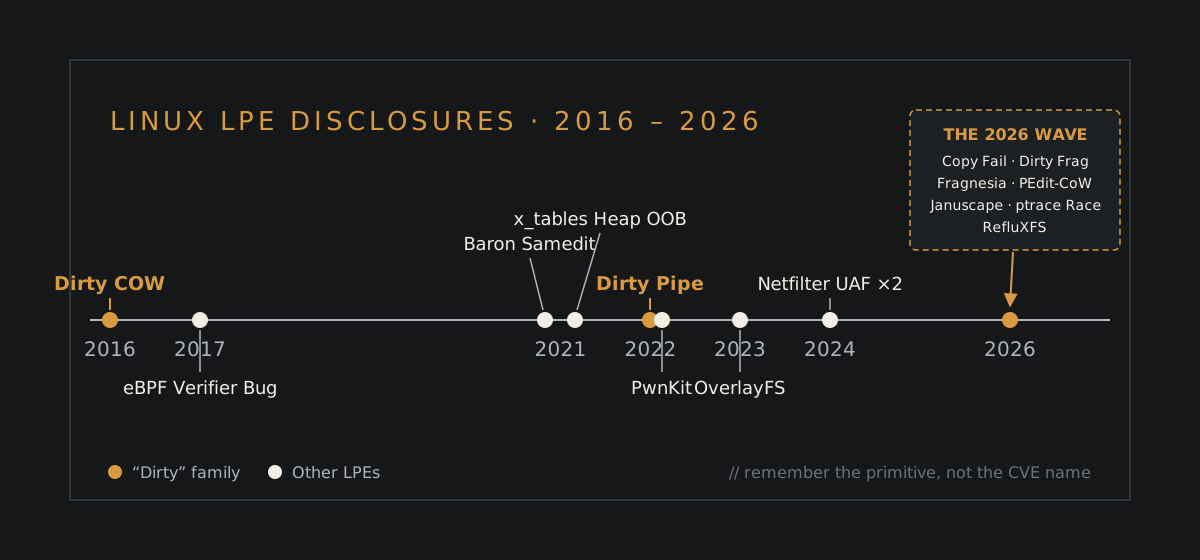
A decade of Linux privilege escalation — and the “Dirty” family just keeps coming back.
The Basics of Access
Local Privilege Escalation is the act of exploiting a bug, a misconfiguration in the OS or software, or an outright design flaw — with the whole and sole goal of getting access to a privileged user that would normally be protected from an application or user like you. On Linux, it usually means moving from a standard user to root.
Root (UID 0) is the superuser account on Linux. Root has unrestricted access over the entire system — getting root is like getting access to MrBeast’s wallet.
There are two other important terms for this article: UserLand and Kernel Space.
UserLand is where your applications run — web servers, text editors, daemons, all of it, executing with restricted privileges outside of the kernel. If the exploitable bug lives here, it’s a UserLand LPE. PwnKit is the classic example.
The kernel, meanwhile, is the core of the operating system. It manages hardware and memory, runs with unrestricted access to system memory, CPU instructions, and everything else. Kernel vulnerabilities are usually far more severe for exactly that reason — and most of the bugs in this article live there.
How Linux Permissions Work
Before understanding how Linux privilege escalation works, we need to understand how Linux hands out permissions to programs in the first place.
Normally, every process on a Linux system runs with the same privileges as the user who started it. You start a program, the program runs as you. Nothing magical happens:
1
2
3
4
5
6
7
User (anirudh)
      │
      ▼
Runs a program
      │
      ▼
Program executes with anirudh's permissions
This mechanism is what stops normal users from reading sensitive files, modifying system configuration, creating user accounts, loading kernel modules, or rewriting firewall rules.
But some legitimate system programs genuinely need privileged permissions when executed by normal users:
- When you change your own password, something has to write to
/etc/shadow— which only root can modify. sudomust execute commands as root.mountneeds elevated privileges to mount filesystems.
Linux provides two mechanisms to make this work safely: SUID and Linux Capabilities. Both allow processes to perform privileged actions, but they work completely differently — and both are prime hunting ground during privilege escalation.
SUID
SUID stands for Set User ID. It’s a special permission bit applied to executable files. When an executable has the SUID bit set, the program runs with the permissions of the file’s owner, not the user who launched it.
Normally:
1
2
3
4
User executes program
        │
        ▼
Program runs as the user
With SUID:
1
2
3
4
5
User executes program
        │
        ▼
Program temporarily becomes
the owner of the executable
If the executable is owned by root, the program temporarily gains root privileges while running.
Example
Suppose we have:
1
-rwsr-xr-x 1 root root passwd
Notice the s in the owner’s execute position:
1
2
3
-rwsr-xr-x
    ^
    SUID
The owner is root. Now imagine a normal user runs passwd. Even though the user is not root, the program executes as root. Why? Because passwd needs to modify /etc/shadow, which is writable only by root. Without SUID, changing your own password simply wouldn’t be possible.
Why Attackers Love SUID
Because SUID programs execute with elevated privileges, any vulnerability inside them becomes extremely dangerous. Imagine a SUID program that executes another command insecurely:
1
system("backup.sh");
If an attacker can manipulate the environment or replace backup.sh, they might force the program to execute their own commands as root. This is why so many LPE vulnerabilities target SUID binaries.
Some commonly abused SUID programs include:
sudopkexecfindvimlesscpbash(when misconfigured)
During a privilege escalation assessment, one of the first enumeration steps is:
1
find / -perm -4000 -type f 2>/dev/null
This lists every file with the SUID bit enabled.
Linux Capabilities
Historically, Linux only had two privilege levels: root or not-root. If a program needed one privileged operation, it often had to run as full root. That violates the Principle of Least Privilege, which says:
A program should receive only the permissions it actually needs — nothing more.
To fix this, Linux introduced capabilities. Instead of handing over complete root access, the kernel can grant individual privileged abilities.
Think of root as a collection of powers rather than one giant permission:
1
2
3
4
5
6
7
8
9
10
Root Privileges
│
├── Bind to low ports
├── Change file ownership
├── Load kernel modules
├── Configure networking
├── Change system time
├── Kill arbitrary processes
├── Mount filesystems
└── ...
Capabilities split these powers into independent units, and a process can receive only the capability it needs without gaining all the others.
For example, suppose a web server wants to listen on port 80. Ports below 1024 require root, so without capabilities the web server must run as full root. With capabilities, the server gets exactly one thing:
1
CAP_NET_BIND_SERVICE
Now it can bind to port 80 without ever becoming root — and if that web server gets popped, the attacker inherits far less than they would have otherwise.
| Capability | Allows |
|---|---|
CAP_NET_BIND_SERVICE | Bind to ports below 1024 |
CAP_SYS_ADMIN | Perform many system administration tasks (very powerful) |
CAP_SETUID | Change user IDs |
Attackers look for capabilities for the same reason they look for SUID bits: a binary with dangerous capabilities may never be marked SUID, yet it can still perform privileged operations. If a binary holds CAP_SETUID and contains a vulnerability, an attacker may be able to change its effective user ID to root. During assessments, the go-to enumeration command is:
1
getcap -r / 2>/dev/null
This recursively lists every file with capabilities assigned.
Why This Matters for Privilege Escalation
When attackers land on a Linux machine, they rarely stop at a normal user shell — the next objective is always root, because root has unrestricted control over the system. To get there, attackers hunt for mechanisms that already possess elevated privileges. The two big ones are SUID binaries (which execute as their owner) and capabilities (which grant specific privileged operations without full root).
If either of those mechanisms is misconfigured or contains a software vulnerability, it can be abused to perform actions beyond the attacker’s original permissions — which is precisely how Local Privilege Escalation happens. This is why almost every Linux privesc checklist starts by enumerating SUID binaries and assigned capabilities. They’re usually the most promising path to root.
Common Vulnerability Mechanisms
Most Linux privilege escalation vulnerabilities rely on a handful of recurring mechanisms. Before we look at real CVEs, let’s nail down the four that matter most:
- Race Conditions / Time-Of-Check-To-Time-Of-Use (TOCTOU)
- Copy-On-Write (CoW)
- Use-After-Free
- Out-Of-Bounds Write
Race Conditions and TOCTOU
Race conditions are famous for finding LPEs — most of the vulnerabilities in this article lean on them in some way.
Modern operating systems perform thousands of operations simultaneously. Multiple programs, processes, and threads may try to access the same resource at nearly the same time. A race condition occurs when the correctness of a program depends on the precise timing of two or more operations. If an attacker can squeeze an action in between two critical operations, they can trick the program into doing something it was never meant to do.
Consider a literal race: an operation trying to complete its task safely, and an attacker trying to interfere before the task finishes. Whoever wins the race decides what happens — hence “race condition.”
TOCTOU (Time-Of-Check-To-Time-Of-Use) is the classic race condition pattern. Imagine a program that wants to delete a file only if it belongs to the current user:
1
2
3
if (file_belongs_to_user("data.txt")) {
    delete_file("data.txt");
}
Between checking the file and deleting it, there is a small time gap:
1
2
3
4
5
6
7
8
9
             CHECK                    USE
               ↓                       ↓
       ┌────────────────┐      ┌──────────────┐
       │ Is data.txt    │      │ Delete       │
       │ owned by me?   │      │ data.txt     │
       └────────────────┘      └──────────────┘
                 \                /
                  \              /
                      TIME GAP
An attacker exploits that gap:
1
2
3
4
5
6
7
Program:  "data.txt belongs to me"
                 ↓
           [TIME GAP]
                 ↓
Attacker: swaps data.txt → /etc/passwd
                 ↓
Program:  deletes /etc/passwd
The program checked one object, but by the time it used it, it was a different object entirely.
A more realistic privileged-program version looks like this:
1
2
3
if (access("/tmp/file", W_OK) == 0) {
    fd = open("/tmp/file", O_WRONLY);
}
access() checks whether the file is writable. But between access() and open(), an attacker can replace /tmp/file with a symlink pointing somewhere else entirely.
Copy-On-Write
One of the most important places you encounter CoW is fork():
1
fork();
When a process calls fork(), Linux creates a child process. You might imagine it works like this:
1
2
3
4
5
Parent
  ↓
Copy entire memory
  ↓
Child
That would be brutally expensive if the parent has hundreds of MB or even GB of memory. Instead, Linux uses Copy-on-Write: initially, both processes’ virtual memory pages point at the same physical pages, and those pages are marked read-only:
1
2
3
4
              Physical RAM
            ┌──────────────┐
Parent ────►│   Memory     │◄──── Child
            └──────────────┘
If both processes only read, everything stays shared and cheap:
1
2
3
Parent ──READ──┐
               ├──► Same physical page
Child  ──READ──┘
The moment one side writes, the kernel steps in. Say the child executes x = 100;. Writing to a shared read-only page triggers a page fault, and the kernel creates a private copy:
1
2
3
4
5
6
7
8
9
10
11
Child
  │ WRITE
  ▼
Page fault
  │
  ▼
Kernel creates a copy
  │
  ├──── Parent → Original page
  │
  └──── Child  → New page
Keep this picture in your head. Dirty COW, PEdit-CoW, and RefluXFS are all about breaking assumptions in this exact machinery.
Use-After-Free
Use-After-Free is a memory-safety vulnerability that occurs when a program keeps using memory after it has already been freed. After free(), the program no longer owns that memory:
1
2
3
4
5
6
7
8
char *data = malloc(100);

strcpy(data, "Hello");

free(data);

/* ❌ Use-After-Free */
printf("%s\n", data);
What’s happening under the hood:
1
2
3
4
5
6
7
8
9
10
11
12
13
14
15
16
17
malloc()
   ↓
┌──────────────┐
│ "Hello"      │
└──────────────┘
      ↑
     data

free(data)
      ↓
Memory is released
      ↓
┌──────────────┐
│  AVAILABLE   │
└──────────────┘
      ↑
     data
The pointer data still contains an address, but the memory at that address is no longer valid for the program to use. So printf("%s", data); after the free is textbook Use-After-Free.
Why do attackers care? Because freed memory doesn’t vanish — it gets reused. If an attacker can control what gets allocated into that freed chunk, the old code path ends up operating on attacker-controlled data. We’ll see this exact trick in the Netfilter section.
Out-of-Bounds Write
An out-of-bounds write happens when a program writes outside the memory space it was allocated — whether that’s a variable, an array, a buffer, or an object. In simple terms: the program writes past the boundary it’s allowed to use.
Simple C example:
1
2
3
4
5
6
7
8
9
int arr[5];

arr[0] = 10;
arr[1] = 20;
arr[2] = 30;
arr[3] = 40;
arr[4] = 50;

arr[5] = 60;   // ❌ Out-of-bounds write
arr has five elements:
1
2
3
4
5
6
Index:    0    1    2    3    4
         ┌────┬────┬────┬────┬────┐
Memory:  │ 10 │ 20 │ 30 │ 40 │ 50 │
         └────┴────┴────┴────┴────┘
                                   ↑
                                boundary
But arr[5] = 60; tries to write past the end:
1
2
3
4
5
6
7
         ┌────┬────┬────┬────┬────┐
         │ 10 │ 20 │ 30 │ 40 │ 50 │
         └────┴────┴────┴────┴────┘
                                     │
                                     ▼
                             ❌ Write outside
                                the array
The program is writing into memory that doesn’t belong to arr. In userland that’s already bad news; inside the kernel, corrupting an adjacent object can mean game over for the whole system.
Now Let’s Talk About the Real Stuff
We’ve covered the fundamentals. We know UserLand from Kernel Space, how SUID and capabilities grant privileges, and the four vulnerability mechanics that power most LPEs.
Time for the actual point of this article: the CVEs.
Knowing what a race condition is theoretically is fine, but seeing the same concept used to turn a normal Linux user into root is where things get interesting. And one more thing — I’m not going to just say “this CVE is vulnerable, run this exploit and you’re root.” That teaches you almost nothing. For every vulnerability we’ll try to understand:
1
2
3
4
5
6
7
8
9
What was wrong?
       ↓
Where was it wrong?
       ↓
What primitive did the attacker get?
       ↓
How did that primitive become root?
       ↓
How was it fixed?
That chain is what actually matters when you’re doing Linux privilege escalation.
1) Dirty COW — CVE-2016-5195
Let’s start with the vulnerability that made the word “Dirty” famous in Linux privilege escalation.
Dirty COW stands for Dirty Copy-On-Write, and yes — it attacks exactly the CoW concept we just discussed. The vulnerability lived in the kernel’s memory management code: a race condition in the handling of Copy-on-Write memory mappings.
Normally, if a process has a read-only private mapping and tries to modify it, Linux creates a private copy of the page. The original read-only page should never be touched. Dirty COW raced the kernel’s memory-management operations such that the attacker ended up with a writable view of a page that should have stayed read-only forever.
In simple terms, the expected flow:
1
2
3
4
5
6
7
8
9
Read-only file
      ↓
Memory mapping
      ↓
Process tries to write
      ↓
Kernel creates private copy
      ↓
Original file remains untouched
Dirty COW breaks that assumption:
1
2
3
4
5
6
7
8
9
10
11
Read-only mapping
       │
       ├──── attacker writes
       │
       └──── kernel performs COW
                │
                ▼
        Race condition wins
                │
                ▼
       Original page modified
Now the interesting question: what can an attacker do if they can modify something they’re only supposed to read?
Quite a lot. If the attacker can manipulate the contents of a privileged executable or another sensitive file, that write primitive becomes a root execution path. Dirty COW didn’t merely give “write access” — it broke a fundamental assumption of the memory management system: a read-only private mapping must not allow modification of the underlying protected data. It affected kernels across the 2.x through 4.x generations before the relevant fixes and was exploited in the wild.
The chain to remember:
1
2
3
4
5
6
7
8
9
10
11
Dirty COW
    ↓
Race Condition
    ↓
Copy-On-Write handling
    ↓
Write to protected memory
    ↓
Modify privileged data
    ↓
Privilege Escalation
This is probably the best example of why understanding CoW plus race conditions pays off.
2) Dirty Pipe — CVE-2022-0847
Six years after Dirty COW came the next famous “Dirty” bug: Dirty Pipe. Unlike Dirty COW, it doesn’t attack copy-on-write directly. It abuses something much more interesting:
1
pipe + splice() + page cache
The root cause was incorrect initialization of flags in the Linux pipe buffer implementation. Those stale flags could make a pipe buffer be incorrectly treated as mergeable. Why does that matter? Because Linux uses the page cache as backing storage for file data. Dirty Pipe found a way to get a pipe buffer associated with a page belonging to a read-only file — then data written through the pipe could affect that page-cache page.
Sit with that for a second. The attacker has:
1
READ access
but somehow obtains a:
1
WRITE primitive
against the page cache of a protected file. The vulnerability let an unprivileged local user overwrite page-cache pages backed by read-only files — including files the attacker couldn’t normally write. The kicker is that the attacker doesn’t need filesystem write permission at all. The kernel itself performs the write:
1
2
3
4
5
6
7
8
9
10
11
12
13
Attacker
   │
   ▼
pipe()
   │
   ▼
splice()
   │
   ▼
Page cache
   │
   ▼
Protected file's cached page
And this is where Dirty Pipe becomes an LPE: if the attacker can modify something security-sensitive through the page cache, that write can be converted into execution with higher privileges.
Dirty Pipe teaches an important lesson — filesystem permissions are not necessarily the whole story. A file can be -r--r--r-- and you can still affect its cached representation if the kernel has a bug in the code path handling that data. That’s exactly why kernel vulnerabilities are so nasty. The attacker doesn’t convince chmod to hand them anything. They convince kernel code itself to perform an operation it shouldn’t.
3) Copy Fail — CVE-2026-31431
Now we get to one of the newer ones, and it’s interesting because it follows the same general family as Dirty Pipe even though the underlying bug is completely different.
Copy Fail affects the kernel’s algif_aead cryptographic interface. The interesting combination:
1
AF_ALG + splice() + page cache + incorrect in-place cryptographic operation
The bug eventually provides a controlled write into the page cache. The important difference from classic LPEs is that this isn’t primarily about winning a race — it’s a logic flaw. The attacker doesn’t sit around hoping “maybe the race will land this time.” The vulnerable kernel code follows a path that incorrectly allows attacker-controlled data to reach a page-cache page, deterministically. It was publicly disclosed in April 2026, and Red Hat describes it as a local privilege escalation in the kernel cryptographic interface.
Here’s the relationship I really want you to notice:
1
2
3
4
5
6
7
8
9
10
Dirty Pipe
     │  page-cache write
     ▼
Copy Fail
     │  page-cache write
     ▼
Dirty Frag
     │  page-cache write
     ▼
More bugs in the same general family
Attackers don’t search for “new root exploit.” They search for reusable primitives. Once researchers understand how an unprivileged process can make the kernel write into the page cache, they can start hunting for the same mistake in completely different kernel subsystems. That’s how vuln research evolves.
4) Dirty Frag — CVE-2026-43284 and Related
Next up is Dirty Frag, and it continues the page-cache story.
Dirty Frag lives in Linux networking code dealing with shared page fragments. The affected paths include the XFRM ESP subsystem and RxRPC. The core problem: data associated with a page-cache page ends up being modified through a kernel path that assumed it owned a writable buffer. Familiar pattern, right?
1
2
3
4
5
6
7
8
9
Protected file
      ↓
Page cache
      ↓
Kernel networking subsystem
      ↓
Unexpected write
      ↓
Protected page modified
Dirty Frag was disclosed in May 2026 as a local privilege escalation that could also allow container escape. Multiple CVEs are involved in the broader issue — CVE-2026-43284 and CVE-2026-43500 among them, with additional related fixes tracked by distributions.
The important thing isn’t memorizing function names. It’s understanding the primitive:
1
2
3
4
5
6
7
8
9
10
11
Unprivileged user
       ↓
Networking primitive
       ↓
Kernel incorrectly handles shared fragment
       ↓
Page-cache write
       ↓
Modify privileged file
       ↓
Root
This is also why I put Dirty Pipe, Copy Fail, and Dirty Frag back to back. Different vulnerabilities, different subsystems — but the underlying idea rhymes: a kernel subsystem writes somewhere the attacker should only be able to read.
5) Fragnesia — CVE-2026-43503 / CVE-2026-46300
Fragnesia is another 2026 vulnerability family involving socket-buffer fragments. The name comes from the same neighborhood as Dirty Frag — shared fragment information being propagated through networking paths incorrectly.
For us, the important part is the flow:
1
2
3
4
5
6
7
8
9
Network buffer
      ↓
Shared fragment
      ↓
Kernel assumes ownership
      ↓
Write occurs
      ↓
Page cache can be affected
Ubuntu describes Fragnesia as a flaw in the XFRM ESP-in-TCP path allowing a local attacker to escalate privileges or escape a container.
Notice how many recent vulnerabilities are starting to look alike. That’s not an accident. Modern Linux is enormous — filesystems, networking, cryptography, virtualization, memory management, packet processing, namespaces, eBPF, IPC — and all of these subsystems interact. A vulnerability doesn’t need to live in a “privileged program.” Sometimes the dangerous part is simply:
1
2
3
4
Subsystem A
      ↓ passes object to
Subsystem B
      ↓ B assumes something A never guaranteed
That assumption can become an LPE.
6) PEdit-CoW — CVE-2026-46331
This one is a beautiful example of why CoW matters.
PEdit-CoW lives in Linux traffic control, specifically net/sched/act_pedit.c. The pedit action lets packet headers be modified, and before touching a packet buffer the kernel must ensure it holds a private writable copy — that’s literally what Copy-On-Write guarantees.
The buggy implementation calculated the writable range too early:
1
2
3
4
5
6
7
8
9
Calculate writable range
        ↓
Assume this range is enough
        ↓
Process packet-editing keys
        ↓
Actual offset changes
        ↓
Write lands outside the COW'ed area
So part of the buffer could remain shared while the kernel believed it was private. That’s the bug. The kernel writes believing “this memory belongs to me” when reality says “this memory is still shared.” And if that shared memory ultimately refers to a page-cache page, the write can hit protected file data.
CVE-2026-46331’s kernel fix moved the COW operation into the per-key processing path, so the actual write offset is known before making the buffer writable. Sensible.
The resulting chain:
1
2
3
4
5
6
7
8
9
10
11
Bad COW assumption
       ↓
Shared buffer stays shared
       ↓
Attacker-controlled packet modification
       ↓
Unexpected memory write
       ↓
Page-cache corruption
       ↓
LPE
7) Same Primitive, Different Bugs
At this point you might be thinking: “Bro, aren’t all of these the same vulnerability?”
No. And the distinction matters.
| Vulnerability | Main idea |
|---|---|
| Dirty COW | Race in Copy-On-Write memory handling |
| Dirty Pipe | Pipe buffer/page-cache bug |
| Copy Fail | AF_ALG cryptographic path causes page-cache write |
| PEdit-CoW | Incorrect COW range in traffic-control packet editing |
| Dirty Frag | Shared network fragments reach page-cache write paths |
| Fragnesia | Fragment handling flaw in networking/XFRM paths |
Different bug, different subsystem, different root cause. But sometimes — the same final primitive. And that overlap is exactly what makes vulnerability research interesting.
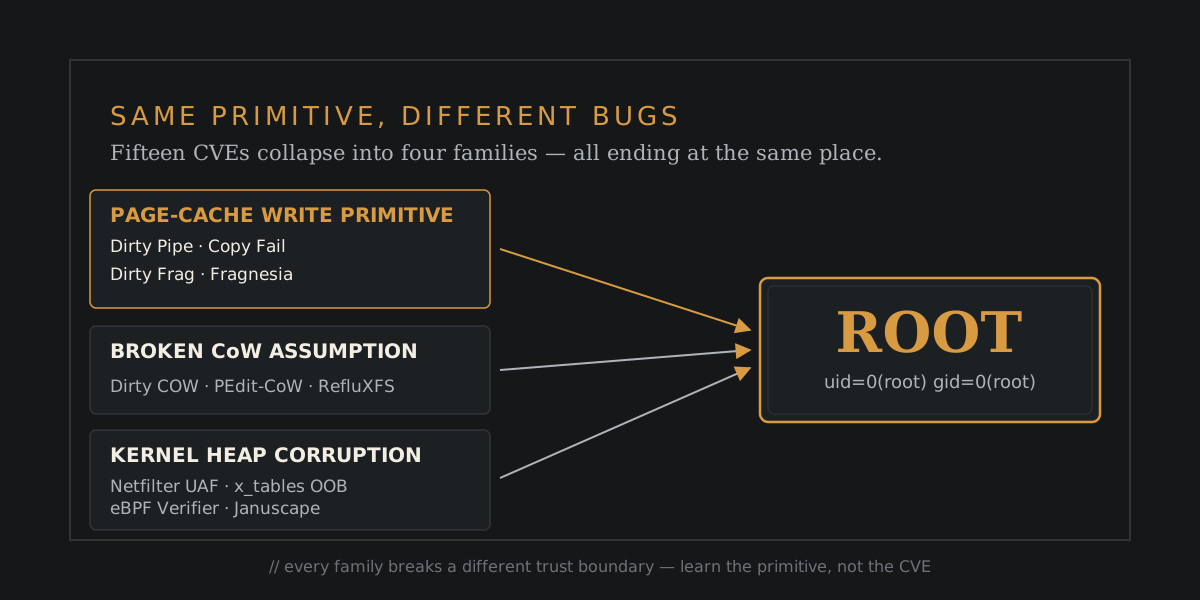
Fifteen CVEs, four families, one destination.
8) Januscape — CVE-2026-53359
Let’s leave the page cache behind, because not every LPE is about files.
Januscape lives deep in the stack:
1
Linux Kernel → KVM → x86 Shadow MMU
KVM is the Kernel-based Virtual Machine subsystem. So instead of the usual normal user → root, the boundary being attacked looks like this:
1
2
3
4
5
Guest VM
   ↓
KVM
   ↓
Host kernel
The rule is supposed to be: guests stay in their box. Januscape breaks it. The bug is a Use-After-Free in KVM’s x86 shadow MMU code — the component managing shadow page tables. A role mismatch could cause KVM to reuse a shadow page incorrectly, letting guest-controlled operations corrupt host kernel state. It hits both Intel and AMD x86 KVM environments, and reportedly saw action as a zero-day in Google’s kvmCTF.
Think about the impact. If I compromise my guest VM, normally I control… my VM. But if the KVM boundary is broken:
1
2
3
4
5
6
7
8
9
10
11
Attacker
   ↓
Guest
   ↓
KVM vulnerability
   ↓
Host kernel
   ↓
Host root
   ↓
Other guests
At that point we’re no longer talking about a regular LPE — we’re talking about a VM escape. Which is why hypervisor bugs get taken extremely seriously.
9) PwnKit — CVE-2021-4034
Back to UserLand. PwnKit is one of the best examples of userland privilege escalation out there.
The vulnerable component is pkexec, part of polkit, and it carries one crucial detail: pkexec ships installed as a SUID-root executable. So the setup is:
1
2
3
4
5
6
7
Normal user
      ↓
pkexec
      ↓
SUID
      ↓
root privileges
The problem: pkexec mishandled its command-line arguments. An attacker could abuse argument and environment processing to make pkexec execute attacker-controlled code — and once arbitrary code runs inside a SUID-root process:
1
2
3
4
5
6
7
Attacker-controlled code
        ↓
pkexec
        ↓
SUID root
        ↓
Root
Game over. Remember earlier when I said SUID programs are dangerous when they contain vulnerabilities? PwnKit is that sentence turned into an actual CVE.
10) OverlayFS — CVE-2023-0386
OverlayFS is interesting because it combines four things that shouldn’t mix badly, yet did:
1
Filesystem + User namespaces + SUID + Permission handling
OverlayFS stacks multiple filesystem layers into one merged view:
1
2
3
4
5
Lower Layer + Upper Layer
        ↓
    OverlayFS
        ↓
 Merged filesystem
The vulnerability related to how OverlayFS handled ownership and capabilities while copying files between mounts — an incorrect UID-mapping/ownership assumption. An attacker could abuse the behavior to place a capable/SUID file somewhere it would execute with elevated privileges.
NVD describes CVE-2023-0386 as an OverlayFS flaw letting an unprivileged local user execute a setuid file with capabilities and escalate privileges. It also earned a spot on CISA’s Known Exploited Vulnerabilities catalog.
The general idea:
1
2
3
4
5
6
7
8
9
10
11
Unprivileged user
       ↓
User namespace
       ↓
OverlayFS
       ↓
Ownership confusion
       ↓
SUID/capable file
       ↓
Root
Another lesson here: Linux namespaces are not automatically a security boundary. They’re extremely useful, sure — but every new boundary means new kernel code, and new kernel code means more places where assumptions can go wrong.
11) Netfilter Use-After-Free — CVE-2024-1085 / CVE-2024-1086
Time for Netfilter — one of those components nearly every Linux admin uses without thinking. It sits underneath iptables, nftables, firewalling, packet filtering, NAT… basically anything firewall-shaped. So when a memory-safety bug shows up in Netfilter, things get interesting fast.
CVE-2024-1085 is a use-after-free/double-free condition in the nf_tables subsystem, involving catch-all set elements handled across generations. Simplified:
1
2
3
4
5
6
7
8
9
10
11
Object exists
    ↓
Kernel decides it should be freed
    ↓
Object state is not tracked correctly
    ↓
Object gets freed again
    ↓
Double free
    ↓
Memory corruption
CVE-2024-1086 is another nf_tables UAF, this time involving nft_verdict_init() and an invalid verdict/error interaction. Both were capable of local privilege escalation.
This is where our Use-After-Free groundwork pays off. Remember — free(object); doesn’t erase the pointer, and the memory can be reused later:
1
2
3
4
5
6
7
8
9
Old object
    ↓
free()
    ↓
Memory available
    ↓
Attacker-controlled object allocated
    ↓
Kernel still treats it as the old object
Now the attacker has a memory corruption primitive. And once you’ve got controlled kernel memory corruption, the usual goal looks like:
1
2
3
4
5
6
7
8
9
Kernel memory corruption
        ↓
Control kernel execution/state
        ↓
Modify credentials
        ↓
UID 0
        ↓
Root
12) Baron Samedit — CVE-2021-3156
We cannot talk Linux privilege escalation without sudo — and more specifically, Baron Samedit.
The vulnerability was a heap-based buffer overflow in sudo, triggered by incorrect handling of escaped backslashes while processing command-line arguments in sudoedit.
Here’s what makes it special: sudo is already a privileged program. Normally:
1
2
3
4
5
6
7
User
  ↓
sudo
  ↓
Authorization check
  ↓
Run command as root
The attacker doesn’t bypass the authorization logic at all. They skip straight past it:
1
2
3
4
5
6
7
8
9
User
  ↓
sudo
  ↓
Memory corruption
  ↓
Code execution
  ↓
Root
That’s a distinction worth internalizing: sometimes you don’t exploit the authentication mechanism — you exploit the program implementing it. Qualys demonstrated working exploitation on systems including Ubuntu 20.04, Debian 10, and Fedora 33, though exact affected versions depend on the installed sudo build.
This is why, during enumeration, I always want to see:
1
sudo --version
Not because every old version is automatically vulnerable — but because version info tells you what attack surface you actually have.
13) eBPF Verifier Bug — CVE-2017-16995
I listed this one up top as “eBPF Map Update,” which honestly undersells it. The actual CVE-2017-16995 root cause is a bug in the Linux eBPF verifier involving incorrect sign extension.
Quick context: eBPF allows user-supplied programs to be loaded into the kernel. Obviously Linux can’t respond to that with “sure bro, here’s kernel execution, do whatever you want” — so eBPF has a verifier:
1
2
3
4
5
6
7
User
  ↓
eBPF program
  ↓
Verifier — is this safe?
  ↓
Kernel execution
That verifier is itself a security boundary. If it wrongly believes a malicious program is safe:
1
2
3
4
5
6
7
8
9
10
11
Malicious BPF
      ↓
Verifier mistake
      ↓
Unsafe operations accepted
      ↓
Kernel memory corruption
      ↓
Potential arbitrary read/write
      ↓
Privilege escalation
CVE-2017-16995 involved incorrect sign extension in check_alu_op() and could lead to memory corruption and potentially arbitrary code execution. The general class is worth remembering: a verifier bug becomes a kernel memory-corruption bug. The verifier doesn’t need to execute malicious code itself — it just needs to approve something that should have been rejected.
14) Netfilter x_tables Heap OOB — CVE-2021-22555
Another great example of the Out-of-Bounds Write concept from earlier.
The vulnerability existed in net/netfilter/x_tables.c and allowed a heap out-of-bounds write when processing certain compat rulesets. The basic problem was a wrong assumption about how much space was available for translated rule data:
1
2
3
4
5
6
7
8
9
10
11
12
Allocated buffer
┌───────────────────────────────┐
│                               │
│          Valid data           │
│                               │
└───────────────────────────────┘
                                ↑
                              boundary

Kernel writes here
                                           ↓
                                    ❌ OOB WRITE
The attacker gets a write outside the intended heap object, corrupting neighboring kernel objects. From there, exploitation becomes the art of turning small memory corruption into a useful primitive:
1
2
3
4
5
6
7
controlled pointer
      ↓
kernel read/write
      ↓
credential manipulation
      ↓
root
CVE-2021-22555 affected kernels going back to the 2.6.19-rc1 era and later landed on CISA’s Known Exploited Vulnerabilities catalog. If you want to learn kernel exploitation, this one is particularly worth studying — it demonstrates how a seemingly tiny heap overflow becomes something much more powerful.
15) ptrace Exit-Race — CVE-2026-46333
A recent one, and it goes right back to our first topic: race conditions.
The vulnerable component is the Linux ptrace access-check path, and the fun happens while a privileged process is exiting:
1
2
3
4
5
6
7
8
Privileged process
        │
        ▼
     do_exit()
        │
        ├── memory released
        │    ← race window
        └── file descriptors closed
There’s a short window where task->mm has already been released while the process still holds its file descriptors. The buggy access-check logic allowed operations during exactly this state, and an attacker racing the condition with pidfd_getfd() can obtain file descriptors belonging to the privileged process.
So instead of attacker → directly become root, the chain looks like:
1
2
3
4
5
6
7
8
9
10
11
Attacker
   ↓
Race privileged process exit
   ↓
Bypass ptrace access check
   ↓
Steal privileged file descriptor
   ↓
Read sensitive data / interact with privileged service
   ↓
Privilege escalation
Red Hat describes CVE-2026-46333 as a process-exit race allowing low-privileged users to access sensitive files or execute commands through stolen descriptors. It’s a lovely modern TOCTOU-style problem: the kernel checks a process at one moment in its lifetime, but the process changes state underneath the check.
And this is exactly why race conditions are so nasty — the code can look perfectly reasonable line by line. The flaw only appears when you ask: “what if another CPU mutates state between these two operations?”
16) RefluXFS — CVE-2026-64600
Finally, the newest bug on our list: RefluXFS.
It lives inside XFS and — once again — involves Copy-On-Write plus a race condition. Full circle, as promised.
The vulnerability exists in XFS’s reflink/CoW path. Reflink lets two files share the same underlying filesystem blocks instead of immediately copying all the data:
1
2
3
File A ─────┐
             ├──► Same physical blocks
File B ─────┘
Great feature — copying huge files gets much cheaper. But sharing blocks creates a synchronization problem: if two operations touch the shared data at the wrong time, the kernel must separate the blocks before modification. RefluXFS races exactly that logic, and the result can be far worse than corrupting the attacker’s own file — protected file contents can be overwritten on affected XFS filesystems. Which immediately gives us our LPE primitive:
1
2
3
4
5
6
7
8
9
10
11
Normal user
     ↓
XFS reflink race
     ↓
Overwrite readable protected file
     ↓
Modify privileged target
     ↓
Execute privileged code
     ↓
Root
Qualys disclosed CVE-2026-64600 in July 2026 and reported successful exploitation against affected XFS filesystems with reflink enabled.
Note the requirement here: XFS with reflink support. Unlike some kernel bugs where uname -r is nearly the whole analysis, here the filesystem configuration matters too. On a target, check:
1
findmnt -T /
and if root is XFS:
1
xfs_info /
Then look for:
1
reflink=1
Kernel version still matters — but so does the filesystem underneath it.
What Did We Actually Learn From These CVEs?
Step back for a second. We’ve covered a lot of bugs, and there’s a pattern hiding under all of them:
1
2
3
4
5
6
7
8
9
10
11
12
13
14
Dirty COW          → Race + CoW
Dirty Pipe         → Pipe + Page Cache
Copy Fail          → AF_ALG + Page Cache
Dirty Frag         → Network fragments + Page Cache
PEdit-CoW          → Incorrect CoW
RefluXFS           → XFS + CoW + Race
Netfilter UAF      → Use-After-Free
Baron Samedit      → Heap Overflow
x_tables           → Heap OOB Write
PwnKit             → SUID + Argument handling
OverlayFS          → Namespace + Filesystem permission confusion
Januscape          → KVM + Use-After-Free
ptrace Exit-Race   → Race + Privileged process state
eBPF               → Verifier mistake + Kernel memory corruption
Which is why I don’t recommend memorizing CVE names. Remember the primitive.
The Real Privilege Escalation Mindset
When you get a shell on a Linux machine, don’t immediately think “which exploit should I run?” Think like an investigator instead:
1
2
3
4
5
6
7
8
9
10
11
12
13
14
15
16
17
18
19
20
21
22
23
What am I?
        ↓
Which kernel?
        ↓
Which distribution?
        ↓
Which architecture?
        ↓
What SUID binaries exist?
        ↓
What capabilities exist?
        ↓
Can I create user/network namespaces?
        ↓
What kernel modules are loaded?
        ↓
What services are running?
        ↓
What filesystem am I using?
        ↓
Are there known vulnerable components?
        ↓
Can I turn the vulnerability into a useful primitive?
Concretely:
1
uname -a
gives you kernel and architecture information. Then:
1
cat /etc/os-release
tells you the distribution. For SUID:
1
find / -perm -4000 -type f 2>/dev/null
For capabilities:
1
getcap -r / 2>/dev/null
For the filesystem:
1
findmnt
Then start asking questions. Not “can I run Dirty Pipe?” but “is this system in the affected kernel range?”, “do the required kernel features exist?”, and “can the vulnerability actually give me the primitive I need?”
That difference separates people who run exploits from people who understand privilege escalation.
CVE ≠ Automatic Root
Probably the most important thing in this entire article: finding a vulnerable CVE does not automatically mean root.
1
CVE found ≠ root
There are conditions:
1
2
3
4
5
6
7
8
9
10
CVE
 │
 ├── Kernel version
 ├── Architecture
 ├── Configuration
 ├── Required module
 ├── Namespace support
 ├── Filesystem
 ├── Mitigations
 └── Exploit reliability
All of them matter. A vulnerability can exist in the kernel source while your specific machine remains unexploitable because the required module is disabled, user namespaces are turned off, the filesystem is different, or the vendor backported the patch.
That last one deserves emphasis: do not blindly compare uname -r against a random CVE website. Distributions backport security fixes. An Ubuntu kernel reporting 5.x does not automatically mean “old vulnerable kernel” — the vendor may have backported the patch while keeping the versioning scheme intact. Always check the distribution’s security advisory too.
Final Thoughts
Linux privilege escalation isn’t about collecting hundreds of exploit scripts. It’s about understanding the relationship between:
1
2
User → Process → Permissions → Kernel → Memory
     → Filesystems → Namespaces → Privileged Components
Once you understand that relationship, CVEs become dramatically easier to digest:
- Dirty COW teaches us Copy-On-Write + race conditions
- Dirty Pipe teaches us pipes + page cache
- Copy Fail teaches us that kernel subsystem interactions can create unexpected primitives
- PwnKit proves a vulnerable SUID program is an instant privesc path
- Baron Samedit shows why memory corruption inside privileged utilities is lethal
- Netfilter bugs demonstrate kernel heap corruption crossing privilege boundaries
- Januscape reminds us that virtualization itself is a security boundary
- RefluXFS brings us home: race conditions + CoW can still break modern Linux
So next time you get a shell on a Linux box, don’t just ask “how do I get root?” Ask:
“What does this system trust that I shouldn’t be able to control?”
That’s where real privilege escalation begins.
References & Further Reading
I kept the write-ups above intentionally conceptual. If you want to go deeper than my summaries, start with these primary sources:
Dirty COW — CVE-2016-5195
- dirtycow.ninja — the original vulnerability site
- NVD: CVE-2016-5195
Dirty Pipe — CVE-2022-0847
- Max Kellermann’s original disclosure — written by the researcher who found it; required reading if you want the full page-cache story
- NVD: CVE-2022-0847
Copy Fail — CVE-2026-31431
Dirty Frag — CVE-2026-43284 / CVE-2026-43500
Fragnesia — CVE-2026-43503 / CVE-2026-46300
PEdit-CoW — CVE-2026-46331
Januscape — CVE-2026-53359
PwnKit — CVE-2021-4034
- Qualys advisory: PwnKit — from the team that discovered it
- PoC exploit by blasty — small enough to read line by line
- NVD: CVE-2021-4034
OverlayFS — CVE-2023-0386
- NVD: CVE-2023-0386 — also listed in the CISA KEV catalog below
Netfilter Use-After-Free — CVE-2024-1085 / CVE-2024-1086
- NVD: CVE-2024-1085
- NVD: CVE-2024-1086
cfreal/ten— CVE-2024-1086 exploitation framework — excellent study material on turning an nf_tables UAF into root
Baron Samedit — CVE-2021-3156
eBPF Verifier Bug — CVE-2017-16995
Netfilter x_tables Heap OOB — CVE-2021-22555
- Google Project Zero: “An iOS hacker tries Android” — Andy Nguyen’s full walkthrough of the bug and its exploitation chain
- NVD: CVE-2021-22555
ptrace Exit-Race — CVE-2026-46333
RefluXFS — CVE-2026-64600
General resources
- GTFOBins — abuse techniques for SUID binaries and sudo misconfigurations you will actually meet in the field
- Linux capabilities man page — every capability flag explained by the kernel docs themselves
- CISA Known Exploited Vulnerabilities catalog — check this before trusting any CVE as “actively exploited”
If any of the NVD or vendor links above look stale when you read this, search the CVE ID directly — advisories move around more often than the identifiers do.